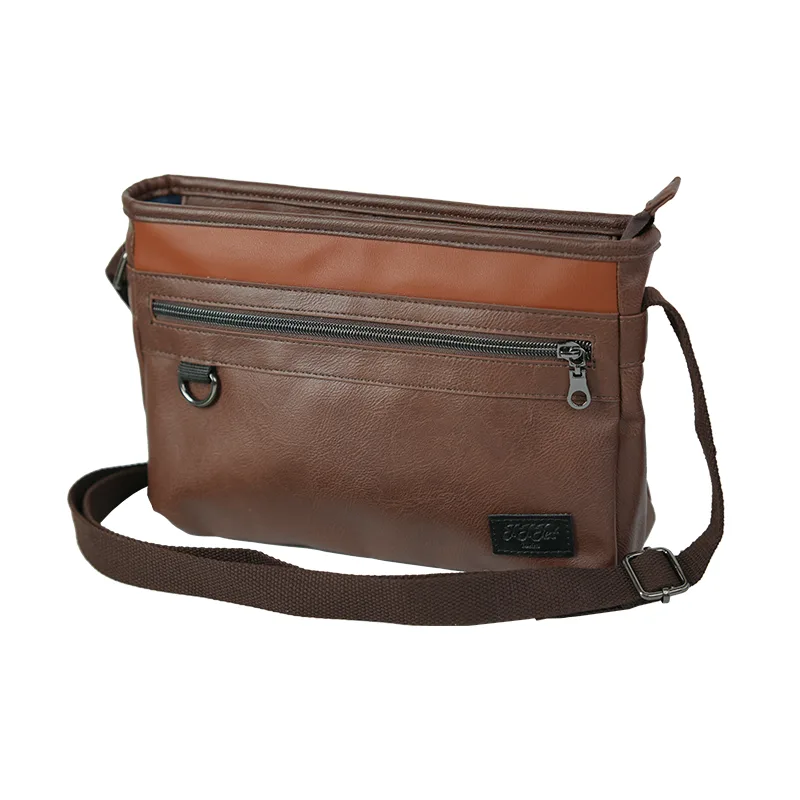
All load of a sling bag concentrates on the two connection points between shoulder strap and bag body, which are the highest stress areas of the bag. Repeated pulling load comes from walking vibration and heavy contents. Simple straight stitching makes threads bear concentrated tension continuously. Yarns gradually break, leading to stitch failure and fabric tearing. Soft materials such as canvas, nylon and PU are more prone to this defect.
Common structural reinforcement schemes
1. Reinforcing patch (the most common solution)
An extra reinforcing patch is added on the inner side of the bag at the joint. High-density oxford fabric, thick PU, microfiber or webbing patch can be used. The patch size shall be larger than the stitching zone to spread tension over a wider area of the bag body. The shoulder strap webbing is sandwiched between the outer fabric and reinforcing patch before sewing.
2. Webbing loop /bridge webbing reinforcement
A heavy-duty webbing loop passes through the bag body, and the shoulder strap is fixed onto this loop. Load is carried by the whole webbing instead of pulling the outer fabric directly. This method offers high load capacity and suits larger sling bags often carrying heavy items.
3. Metal fitting base (D-ring /square buckle base)
Metal base clamps the bag fabric and reinforcement layer, fixed with rivets or screws. The shoulder strap attaches to the D-ring. Load is borne by metal parts. It is widely used for structured business-style bags. The downside is higher cost and slight protrusion at the fitting.
4. Multi-layer stitching with backstitch reinforcement
Stitching quality matters for all reinforcement structures. Box stitch, triangle stitch and bar tack are preferred over simple straight stitch. Backstitch at start and end prevents loose threads. Triangle stitch distributes tension in three directions and is a standard heavy-load stitch for bags.
Key points for material selection
The reinforcing patch material should be no weaker than the main fabric. A weak patch makes reinforcement ineffective. Nylon webbing is stronger than common woven fabrics. For PU and leather bags, microfiber or thick leather patches are preferred. Avoid excessive stacked thickness, which causes sewing difficulty and uncomfortable protrusion.
Auxiliary optimization in design and usage
Joints should avoid curved corners of the bag, where stress naturally accumulates. Wider horizontal spacing between two connection points also helps reduce single-point load.
Reinforcement extends service life rather than providing unlimited load capacity. Overloading still accelerates wear and tearing.
We use cookies to offer you a better browsing experience, analyze site traffic and personalize content. By using this site, you agree to our use of cookies. Privacy Policy